
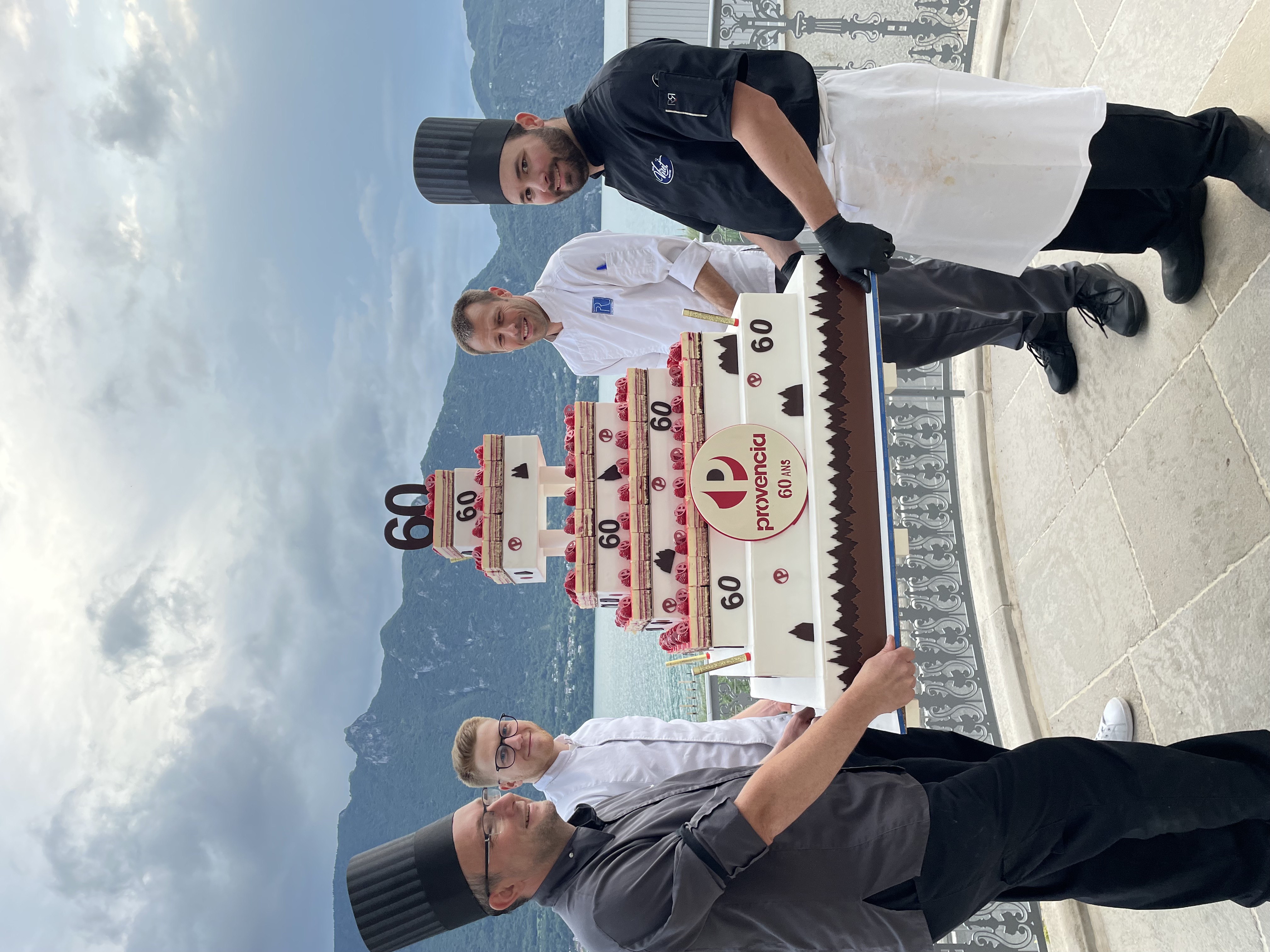
Event Catering in Seville that protects your agenda, brand and guests
Table of contents
In a corporate event, catering is not a “nice-to-have”: it is a visible operational test. If service is slow, diets are missed or the bar runs dry, the room stops listening—especially in executive audiences where attention spans are short and schedules are tight.
Organizations in Seville expect generosity and warmth, but with corporate discipline: accurate timings, correct invoicing, risk controls, and a service style aligned with the brand (from discreet luxury to energetic product-launch formats).
INNOV'events works locally with a proven vendor pool and on-the-ground coordinators. We combine Andalusian hospitality with process: run sheets, staffing plans, HACCP-aligned food safety, and contingency scenarios that hold up under real event pressure.
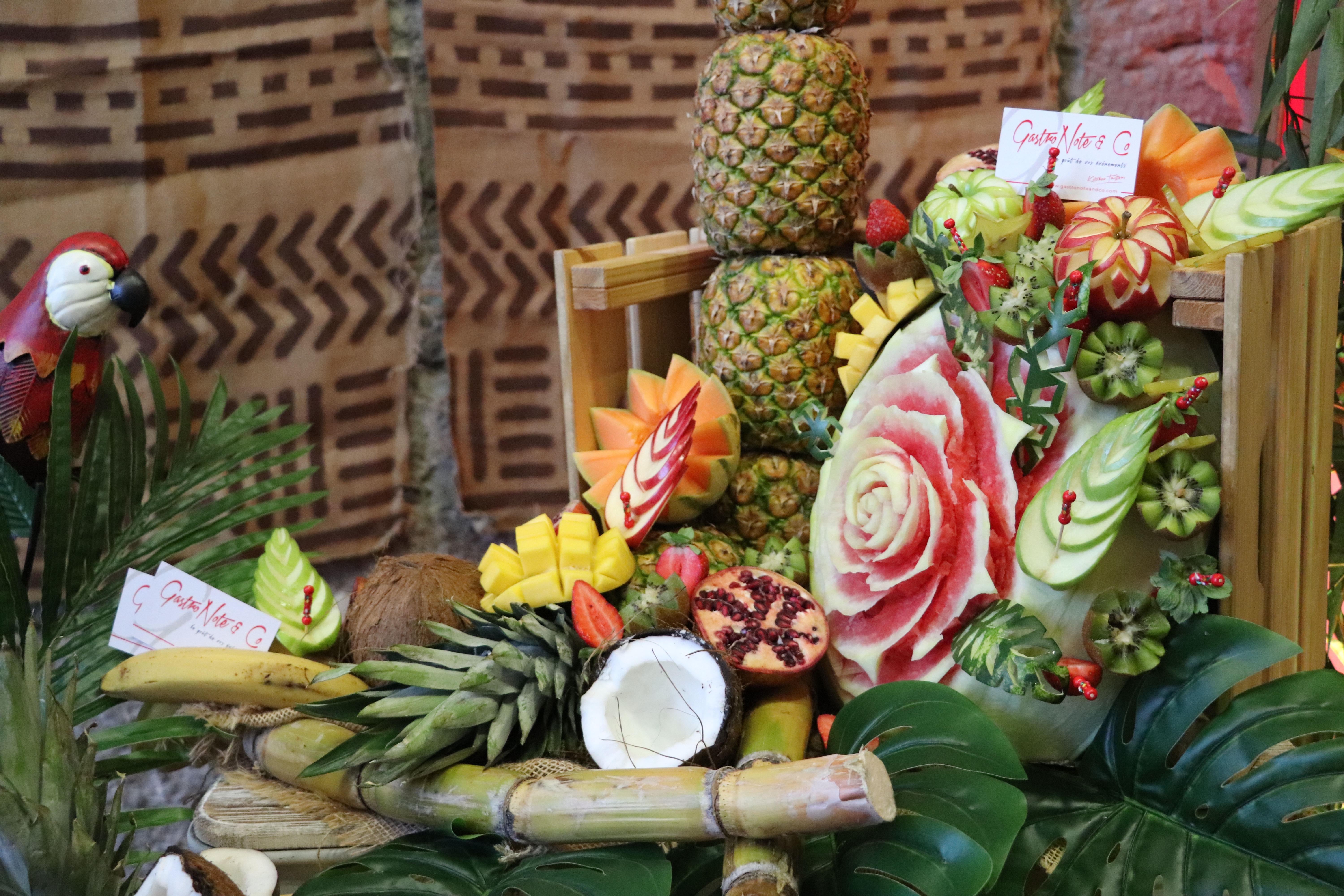
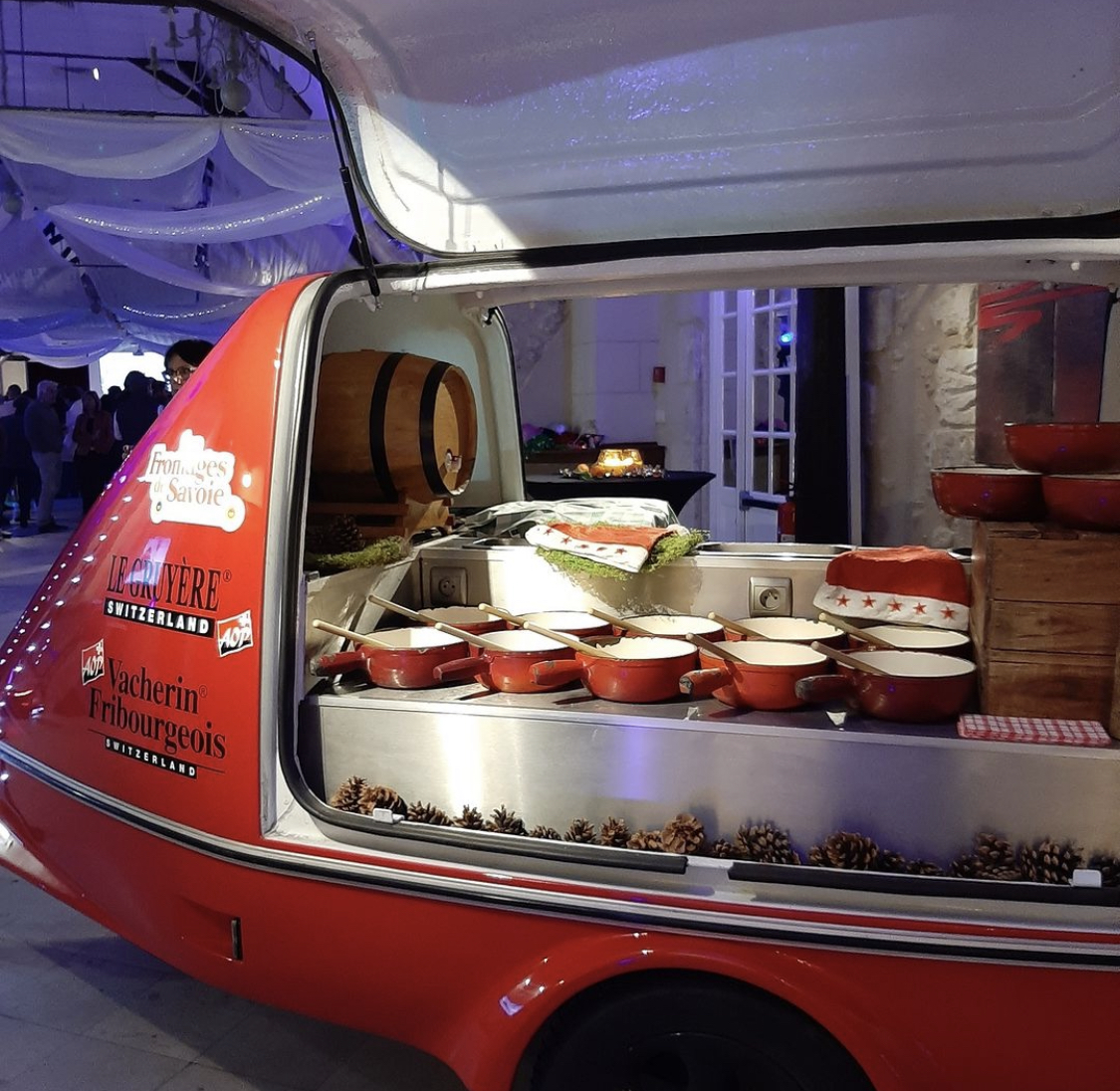
Operational credibility for Seville decision-makers
10+ years delivering corporate events across Spain with a stable network of vetted caterers and technical partners.
300+ corporate events/year supported through our national production methodology (procurement, scheduling, risk and supplier management).
Capacity to serve from 30 to 2,000+ guests with controlled service ratios (kitchen, floor staff, bar, logistics).
24–72h typical turnaround for a first proposal (depending on venue confirmation and technical constraints).
Documented processes: allergen matrices, service briefings, delivery checklists, and incident logs for continuous improvement.
How to organize a professional event in Seville?
- Define the objective (cohesion, announcement, fidelity, performance).
- Set date, format and size (20–1 000 people).
- Secure the venue and accommodation according to seasonality.
- Lock down technical, suppliers and logistics.
- Drive the day J (timing, scene, entrance, flow).
Who we support in Seville and the 41 department
In Seville and across the 41 department, we typically support HR, Corporate Communications, Executive Assistants, and Procurement teams who need a reliable partner rather than “just a caterer”. Many of our clients renew year after year because they want the same outcomes: predictable delivery, consistent guest experience, and zero drama on event day.
You mentioned you would provide company names to use as references; please share them and we will integrate them exactly as requested. Until then, we can describe comparable profiles we regularly work with in the area: industrial groups hosting plant visits, tech teams running product demos, hospitality brands launching partnerships, and professional services firms organizing leadership offsites.
Our local approach is simple: we keep a short list of caterers and staffing providers we know personally, we validate their last-mile logistics in the streets and loading conditions of Seville, and we only propose solutions we can actually execute within the venue’s constraints.
We send you a first proposal within 24h.
Why invest in Event Catering for Seville corporate events?
For executives, catering is a lever to control energy in the room. When the food flow matches the program, people network at the right moments, discussions stay focused, and your key messages are heard under the best possible conditions.
In practice, the catering plan becomes a management tool: it structures arrival, creates “intentional encounters” between teams, and reduces friction during transitions (registration, plenary, breakouts, awards, closing drinks).
Protect executive time: a disciplined service sequence avoids program drift, which is one of the most frequent complaints from leadership teams after internal events.
Support HR objectives: well-designed stations and break rhythms increase cross-team interaction (especially after reorganizations, mergers, or post-peak periods when engagement is fragile).
Strengthen corporate image: consistent tableware, uniform standards, and bar control avoid the “inconsistent vendor feel” that damages brand perception.
Reduce operational risk: allergen management, temperature control, and staffing ratios reduce the probability of incidents that could escalate quickly in a company setting.
Make budgets predictable: clear cost drivers (menu complexity, service style, venue restrictions, staffing) allow Procurement to compare offers fairly.
Seville is a relationship-driven business environment: people remember how an event felt and how well it was run. Good Event Catering reinforces trust; poor execution is discussed long after the last guest leaves.
What Seville stakeholders expect from corporate catering
Local expectations in Seville are demanding because the city is both highly hospitable and highly professional. Guests are used to good food—so “average” is not neutral; it is noticed. At the same time, corporate hosts are judged on punctuality and control, not only on taste.
From field experience, here are the recurring expectations we manage for HR and Comms teams:
- Timing discipline: breakfasts and coffee breaks must be ready 15–20 minutes before the first arrivals; lunch service should never start late because speakers overrun. We build buffers and service pacing into the run sheet.
- Heat and seasonality: in warmer months, menus must resist temperature swings and outdoor logistics (cold chain, hydration points, shaded stations). In winter, warm items must remain stable without degrading texture.
- Dietary and cultural coverage: vegan/vegetarian, gluten-free, halal-friendly options and clear allergen signage are standard in international groups. We plan a menu architecture where “special diets” are not an afterthought.
- Venue access realities: many venues in the historic center have limited loading windows, narrow access, or strict noise rules. We design production around those constraints (pre-plating, satellite stations, silent service where needed).
- Invoice clarity: corporate finance teams need clean lines for food, beverage, staff, rentals, logistics, and contingencies. We structure proposals so you can validate and reconcile quickly.
This is why our role is not to propose the fanciest menu; it is to propose the menu that survives the venue, the program, and the audience profile—without creating extra work for your internal teams.
Which catering activations work best in Seville events?
In corporate settings, “activation” is not about spectacle; it is about creating structured interaction without harming flow. The right catering moments can increase conversation density, reduce awkward downtime, and reinforce your message—especially in Seville, where social dynamics are central but timekeeping remains critical.
Interactive animations in Seville
Guided tasting stations: a short, scripted tasting (3–4 bites) hosted by a trained staff member. Works well for client events because it creates a natural reason to gather and talk, without turning into a full show.
Networking-friendly layout: multiple identical stations to avoid queues, plus “conversation pockets” (high tables in clusters of 4–6). This is one of the most effective levers for HR when mixing teams after organizational changes.
Timed micro-breaks: a refresh point that opens and closes with the agenda (e.g., 12 minutes service window). It maintains punctuality and reduces the “coffee break that never ends”.
Art animations in Seville
Discreet live music during cocktail: small-format acoustic sets with controlled volume to protect conversations. In executive audiences, music must never compete with business discussion.
Cultural cues without clichés: subtle Andalusian references (guitar duo, curated playlist, or design elements) can anchor the event in Seville while staying corporate. The key is moderation and brand fit.
Innovative animations in Seville
Seville-inspired menus with corporate execution: reinterpretations of local classics delivered with consistent portioning and allergen labeling. The objective is familiarity with precision, not folklore.
Healthy performance catering: high-protein, low-sugar, and hydration-led breaks for long conferences. We often deploy this for leadership offsites where cognitive load is high.
Zero-waste minded formats: controlled portioning, donation pathways where feasible, and waste tracking. Useful when Communications teams need ESG coherence that is visible and reportable.
Gourmand animations in Seville
Data-led bar management: pre-defined consumption assumptions (e.g., 1.5–2.5 drinks/person for a 90-minute cocktail) and controlled replenishment to avoid both shortage and overspend.
Speed service engineering: dual-sided bars, pre-batched cocktails, and “grab & go” dessert formats that keep queues under control at peak moments.
Brandable tasting moments: edible branding used sparingly (e.g., dessert topper, napkin band, menu card) so the brand feels present without looking promotional.
Whatever the activation, we align it with your brand posture and audience: a listed company’s investor cocktail does not follow the same codes as an internal celebration. Strong Event Catering feels consistent with who you are—and never creates friction for the program.
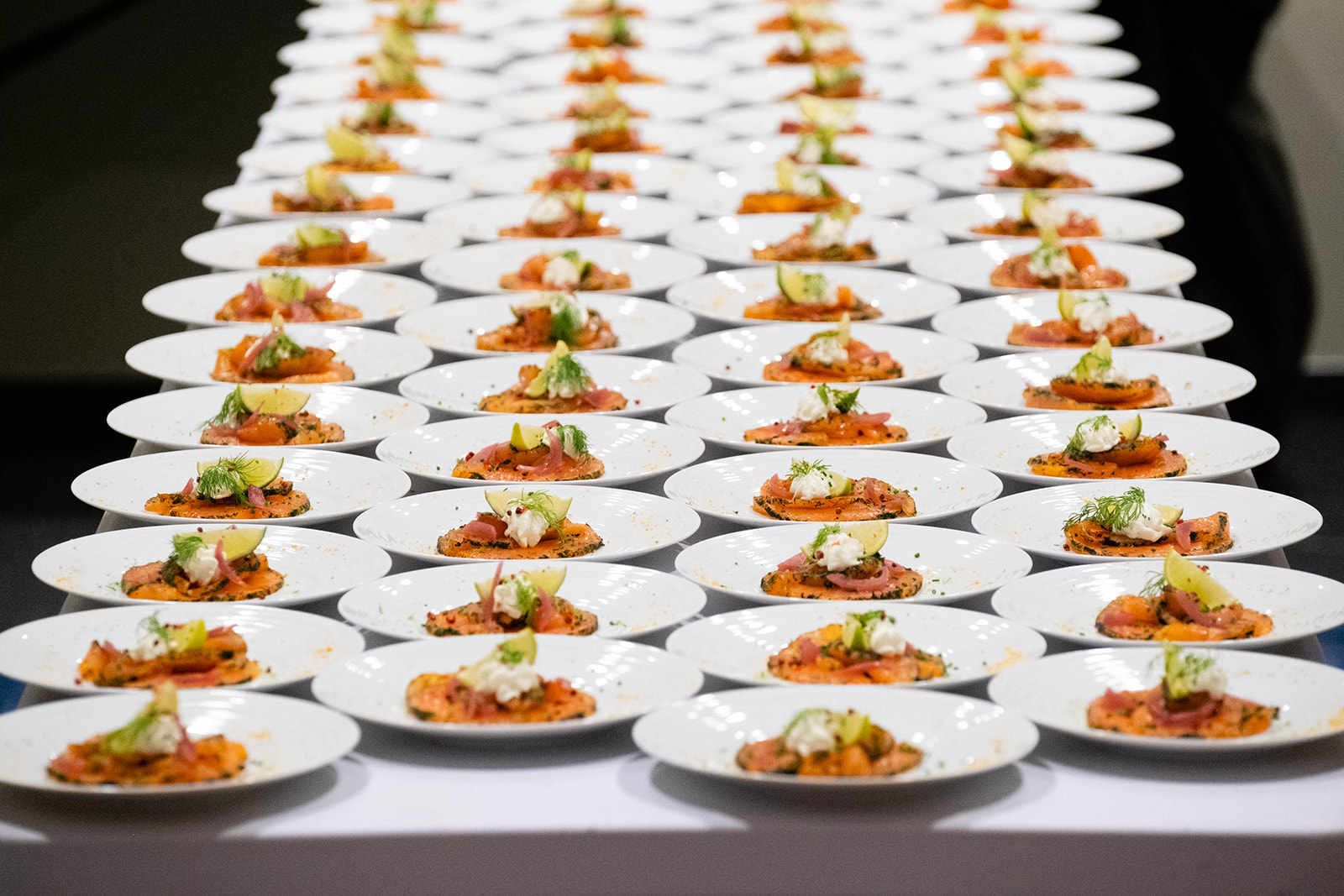
How to choose a Seville venue that supports catering logistics
The venue dictates what catering can realistically achieve. In Seville, this is particularly true because access conditions can be restrictive: loading schedules, protected areas, limited elevators, and outdoor spaces sensitive to weather. A venue that looks perfect in photos can become a risk if service routes are complex.
We evaluate venues through a catering lens: kitchen capacity (or need for a temporary kitchen), power availability, water points, storage, waste routes, staff changing areas, and guest circulation. This protects your schedule and prevents hidden costs.
| Venue type | For which objective? | Main strengths | Possible constraints |
|---|---|---|---|
City-center hotel with banqueting | Board dinners, conferences, award nights | Built-in kitchen, trained staff, predictable timing, back-up spaces | Less flexibility on suppliers, corkage policies, fixed service rules, parking/loading limits in central areas |
Historic venue / cultural space | Client receptions, brand events, leadership gatherings | High perceived value, strong local identity linked to Seville, excellent for storytelling | Strict protection rules, limited prep areas, noise/time restrictions, complex access for trucks and cold chain |
Industrial / corporate site (HQ, plant, showroom) | Factory tours, investor visits, internal milestones | Total brand control, logistics familiarity for your teams, strong authenticity | Need for temporary kitchen and rentals, safety inductions, route segregation, higher responsibility on host for compliance |
Site visits are not optional. We do a technical walk-through focused on catering flows and risk points (access, storage, power, waste). It is the fastest way to eliminate surprises and to confirm the service model and staffing plan.
What does Event Catering cost in Seville (and why)?
Pricing for Event Catering in Seville depends on operational complexity more than on the menu alone. Two events with the same headcount can have very different budgets if one requires a temporary kitchen, extended service hours, or strict access windows.
For decision-makers, the key is to separate “headline price per person” from the full delivery cost: staffing, rentals, bar, logistics, and contingency.
Format: coffee break, cocktail, seated lunch/dinner, stations, or hybrid. Seated formats are staffing- and timing-intensive; stations can reduce staff but increase equipment and replenishment.
Guest count and service duration: a 90-minute cocktail and a 4-hour gala dinner require different staffing and consumption assumptions.
Venue infrastructure: on-site kitchen vs. off-site finishing vs. full temporary kitchen (power, refrigeration, prep tables, dishwashing). Temporary kitchens can materially change the budget.
Staffing ratios: number of waiters per zone, bar points, captains, runners, cleaning. Corporate audiences notice under-staffing immediately (queues, empty trays, dirty glassware).
Rentals and styling: glassware count, plate and cutlery changes, linen, high tables, lounge. “Minimal” can look premium if coherent; “random” always looks cheap.
Beverage strategy: open bar vs. limited selection, premium spirits, wine pairing, alcohol-free sophistication. Bar design is a major cost driver and a major satisfaction driver.
Dietary coverage and labeling: special diet plating, separate handling, signage, and staff briefing time.
Timing and access constraints in Seville: restricted loading windows, long distances from truck to service area, or heritage constraints increase labor and planning.
We build budgets with a return-on-control mindset: spend where it protects the program (staffing, flow, cold chain) and simplify where it does not add value (over-complex menus, unnecessary rental layers). This is how you keep quality high while staying defensible for Procurement.
Why use an event agency in Seville for catering management?
Corporate catering is a multi-supplier operation: food production, staffing, rentals, bar, logistics, venue coordination, and often AV synchronization. When something fails, it rarely fails alone. A local agency’s advantage is not proximity for its own sake; it is the ability to prevent chain reactions through on-site control and a reliable vendor ecosystem.
As an event agency in Seville, INNOV'events can physically validate logistics, negotiate realistic delivery windows, and mobilize replacement resources quickly. This is particularly valuable for executive and client-facing events where there is zero tolerance for improvisation in front of stakeholders.
- Vendor accountability: one lead partner to manage SLAs, briefings, and corrective actions rather than multiple vendors blaming each other.
- Local operational realism: we plan based on real access routes, parking constraints, and venue rules in Seville, not assumptions.
- Faster troubleshooting: replacement staff, extra ice, additional glassware, or last-minute dietary needs can be handled without destabilizing the event.
- Program protection: we align catering with run-of-show, speakers, and room resets so the agenda stays credible.
We build budgets with a return-on-control mindset: spend where it protects the program (staffing, flow, cold chain) and simplify where it does not add value (over-complex menus, unnecessary rental layers). This is how you keep quality high while staying defensible for Procurement.












What we have delivered across Seville corporate formats
Our catering projects in Seville range from discreet leadership meetings to high-traffic receptions. The common factor is operational pressure: senior guests arrive at the same time, schedules shift, and the event must still feel controlled.
Examples of real situations we manage frequently:
- Executive committee dinner after a full-day seminar: late program finish, VIP dietary constraints, and the need for a calm service tempo. We plan a plated menu with limited last-minute complexity, confirm seating and speeches, and keep a silent reset team so the room transitions cleanly.
- Client cocktail after a product demo: the demo overruns by 12 minutes and guests exit the plenary at once. We design multiple mirrored stations, pre-stage first trays, and open bar points in parallel to prevent a queue from becoming the “first impression”.
- Internal celebration for multi-site teams: mixed seniority, different social habits, and a requirement for inclusive options. We use clear labeling, alcohol-free premium choices, and a flow that keeps people moving while still enabling conversations.
- Training day catering with strict timeboxes: short breaks and rapid room turnover. We use “grab & go” formats, controlled waste, and precise replenishment to keep the training on time.
In each case, the work is not only “food”: it is coordination, staffing design, and anticipation—so your organization looks composed.
Common catering mistakes we prevent in Seville
Underestimating queues: one bar or one station for 200 people creates immediate frustration. We calculate service points and deploy mirrored stations to reduce peak congestion.
No clear allergen system: relying on verbal explanations increases risk. We implement allergen matrices, signage, and a briefing so every server gives consistent answers.
Over-complex menus: too many hot items or last-minute plating steps increase failure probability, especially in venues without full kitchens. We prioritize stable execution over unnecessary complexity.
Ignoring venue access limits: the best menu fails if trucks cannot load-in at the right time. We validate windows, routes, and storage before finalizing proposals.
Mismatch between brand and service style: a premium brand with casual staffing or inconsistent tableware erodes perception. We align uniforms, equipment and service language with your positioning.
Weak water and soft drink planning: in warmer periods in Seville, hydration is a satisfaction and safety issue. We plan volumes and distribution points, not only the food.
Our job is to remove these risks before they reach your guests. We do it through planning, clear roles, and on-site supervision—so you are not managing catering problems between speakers and VIPs.
Why Seville clients renew INNOV'events year after year
Client loyalty in corporate events is rarely emotional; it is operational. Teams come back when delivery is predictable, proposals are transparent, and the agency reduces internal workload rather than creating more decisions and follow-ups.
Single point of contact from proposal to event day, reducing coordination overhead for HR and Comms teams.
Structured post-event debrief with what worked, what to adjust, and cost drivers—useful for internal reporting and continuous improvement.
Vendor continuity when it makes sense (same caterer teams who already know your standards) and vendor change when performance requires it.
Scenario planning (weather, timing drift, VIP changes) as a standard, not an optional extra.

Loyalty is proof of quality because it reflects repeat exposure to real constraints. In Seville, where word-of-mouth within business circles travels fast, consistent execution is the strongest credential.
Our Seville catering process from brief to service
👉 Briefing and constraints capture (Seville)
We start with a 30–45 minute working call to capture: objectives, audience profile (executives, clients, mixed teams), headcount range, timing, venue shortlist, dietary requirements, brand standards, and procurement constraints. We also ask practical questions that change delivery: loading access, service windows, noise restrictions, and whether the program is fixed or likely to move.
👉 Concept, format and service model selection
We propose 2–3 service models (e.g., cocktail + stations, seated + coffee corners, hybrid). For each, we explain operational implications: staffing ratios, equipment needs, timing impact, and guest experience. This is where we prevent “nice idea, impossible venue” scenarios that typically appear late in planning.
👉 Supplier sourcing and tastings
We shortlist local partners in Seville based on format and venue constraints. When relevant, we organize a tasting with decision-makers and align portioning, seasoning, and presentation standards. We also validate non-negotiables: allergen handling, staffing, uniforms, and backup plans.
👉 Budget build and procurement-ready proposal
We deliver a structured quote with clear lines: food, beverage, staffing, rentals, logistics, and optional add-ons. We include assumptions (service duration, consumption ranges, staffing ratios) so Procurement can compare fairly and so Finance has clean reconciliation.
👉 Operational planning and run-of-show integration
We build the production plan: load-in schedules, kitchen/finishing plan, station layout, staff call times, service cues aligned with the agenda, and signage/allergen systems. We coordinate with venue and AV to avoid conflicts (microphone moments, room resets, power sharing).
👉 Event-day supervision and contingency management
An INNOV'events on-site lead manages catering captains, service pace, VIP needs, and incident handling. We track real-time consumption, keep stations replenished, and adjust to schedule drift without breaking guest experience. Your internal teams are not pulled into problem-solving.
👉 Debrief and continuous improvement
Within days, we provide a debrief: feedback, service observations, consumption notes, and recommendations for next time. This is especially useful for HR and Comms teams who need to justify choices and improve future events in Seville.
FAQ sobre la organización Event Catering en Seville
How far in advance should we book catering in Seville?
For Event Catering in Seville, plan 4–8 weeks ahead for standard corporate formats (50–300 guests). For peak dates (spring and early autumn) or complex venues with access limits, aim for 8–12 weeks. For urgent needs, we can sometimes execute in 7–10 days if the venue is confirmed and logistics are simple.
What budget range per person for corporate catering in Seville?
As a practical reference in Seville: coffee breaks often land around €8–€18/person, cocktails commonly €25–€65/person, and seated meals typically €45–€120/person, depending on menu, staffing, beverage level and rentals. Temporary kitchens, premium beverages, and complex venues add cost beyond the menu price.
Can you manage allergies and special diets for Seville events?
Yes. We implement an allergen matrix, clear labeling, and a briefing so staff can answer consistently. For higher-risk setups, we separate production/handling and define a controlled delivery method for special plates to avoid mix-ups. You should expect to share dietary needs at least 5–7 days before the event for best results.
Do you provide staff, bar service and rentals in Seville?
Yes. INNOV'events can cover the full catering scope in Seville: service staff (captain, waiters, runners), bar staff, glassware/plates, linens, high tables, lounge, and logistics. We specify staffing and rental counts in the proposal so you can validate service capacity and cost drivers.
What are common venue constraints for catering in Seville center?
Typical constraints include restricted loading hours, long carry distances, limited elevators, heritage rules (no open flames, limited noise, protection of floors/walls), and reduced storage. These constraints influence whether we finish on-site, use a temporary kitchen, or simplify hot items. We recommend a technical walk-through before locking the menu and service model.
Request a Seville catering proposal with clear assumptions
If you are comparing agencies, we can help you make the comparison fair: we provide a procurement-ready proposal with explicit staffing ratios, service timing, venue assumptions and contingency options.
Send us your date, venue (or shortlist), estimated headcount, and the type of audience (clients, executives, internal). INNOV'events will revert with a structured plan for Event Catering in Seville, including budget ranges and the operational approach needed to deliver confidently on event day.
INNOV'events Seville Agency
Cyril Azevedo is the manager of the INNOV'events Seville office. Reach out directly by email at cyril@innov-events.es or via the contact form.
Contact the Seville agencyAll our services & entertainment Seville
Discover our event services
Discover our event entertainment available in the España
- Event Hostess Seville
- Escape Game Seville
- MasterChef Cooking Workshop Seville
- Magician Seville
- Marquee Rental Seville
- Color Analysis Workshop Seville
- Inflatable Games Seville
- Valet Parking Service Seville
- Football Simulator Seville
- LED Furniture Rental Seville
- Light Branding Seville
- Unique Dining Experience Seville
- Light Painting Seville
- Murder Mystery Party Seville
- Prize Contest Seville
- Promotional Displays (POS) Seville
- Virtual Reality Seville
- Molecular Gastronomy Workshop Seville
- Halloween Entertainment Seville
- Fireworks Show Seville
- Giant Games Challenge Seville
- Event Host / MC Seville
- Photo Booth Animation Seville
- Santa Claus Entertainment Seville
- Kids Entertainment Seville
- Guided Tour Seville
- Urban Rally Seville
- Ball Pit Seville
- Flight Simulator Seville
- Food Truck Rental Seville
- World Record Challenge Seville
- Surf Simulator Seville
- Wine Casino Seville
- Makeover Workshop Seville
- Perfume Creation Workshop Seville
- Acting Workshop Seville
- CSR Activities Seville
- Archery Seville
- Security Staff Seville
- Wine Tasting Seville
- Mime Performer Seville
- TV Game Show Seville
- Funfair Seville
- Crisis Management Workshop Seville
- Crisis Negotiation Workshop Seville
- Arcade Games Seville
- Indoor Skydiving Simulator Seville
- Ski Simulator Seville
- Racing Circuit Experience Seville
- Introductory Flight Experience Seville
- Tasting Experience Seville
- Build Your Own Foosball Workshop Seville
- 2CV Rally Seville
- LEGO Challenge Seville
- Casino Night Seville
- Interpreter / Translator Seville
- Promotional Giveaways Seville
- Shuttle Transport Seville